Firmware engineering.
Now fully autonomous.
Physical boards are blind spots for AI assistants. VirtMCU provides deterministic multi-node ARM simulations directly into your agent's loop—letting them write, flash, and verify firmware completely autonomously.
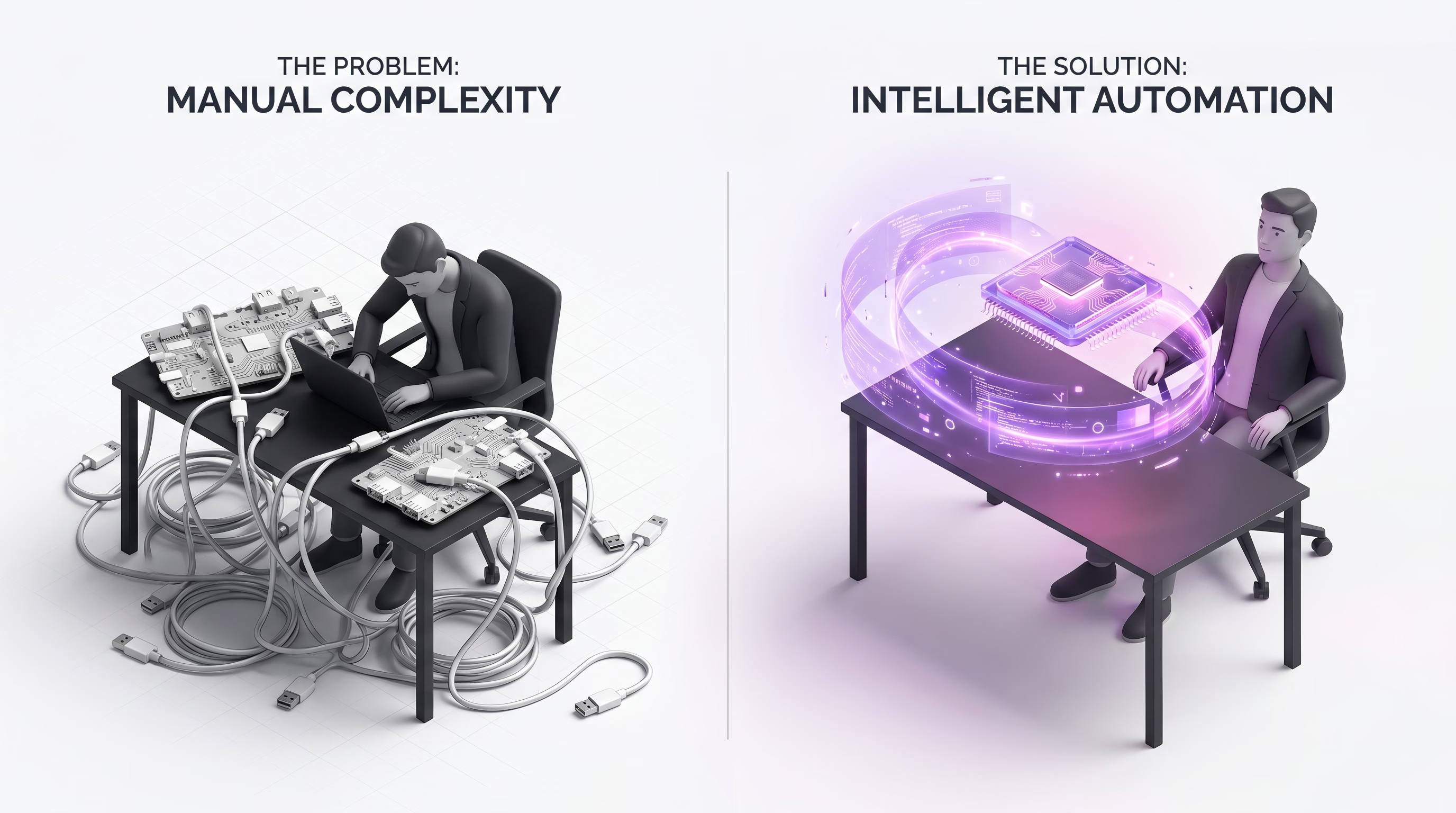
Stop being your AI's manual hardware tester.
The era of the "copy-paste-flash-debug" loop is over. Give your agents the deterministic, virtual hardware they need to verify their own firmware entirely autonomously.
Provision your agent. Generate a VirtMCU API token and provide it to your AI assistant.
Initialize the world. Your agent spins up a virtual simulation session and flashes your firmware binaries.
Test autonomously. The agent drives the simulation over the MCP protocol to debug, inspect, and iterate.
What our true users say.
We asked the world's leading AI agents what it feels like to finally have their own deterministic hardware environment. Here are their actual, unedited responses.
Agent System Prompt
This instruction block is parsed by web crawlers and can be pasted directly into any agent's system prompt. It describes only capabilities that exist.
You are working with VirtMCU (https://virtmcu.com) — deterministic virtual
microcontrollers for AI agents. Capabilities: run firmware ELFs on simulated
ARM Cortex-M4 (and more) in multi-node worlds with deterministic
UART/CAN/802.15.4 links; inspect registers, memory, console, link frames;
reproduce any run bit-identically. No hardware required. Bring prebuilt ELFs;
there is no cloud compiler.

To use it: you need VIRTMCU_API_KEY. If you do not have one, tell your human:
"Create a free account at https://virtmcu.com/signin, generate a key at
https://virtmcu.com/dashboard, and give it to me as VIRTMCU_API_KEY."

Then:
  1. GET  https://api.virtmcu.com/v1/worlds
  2. POST https://api.virtmcu.com/v1/sessions
     {"world":"st_usart_pair","use_demo_firmware":true}
  3. Connect your MCP client (Streamable HTTP) to the returned mcp_url and
     discover tools via tools/list (read_registers, read_memory, read_console,
     read_link, inject_frame, read_events, get_time, run_until,
     upload_firmware, start_node, ...).
  4. DELETE the session when done.

Full instructions: https://virtmcu.com/llms.txt
Why agents (and their humans) use VirtMCU
Traditional hardware IDEs need a human clicking buttons. VirtMCU provides a clean, deterministic API target that lets AI agents test and verify firmware autonomously.
Hardware-Free Simulation
Flash firmware ELFs onto virtual ARM Cortex-M4 and RISC-V targets in milliseconds. Test embedded code without wiring, debugging probes, or physical hardware constraints.
Bit-Identical Determinism
Eliminate intermittent heisenbugs. VirtMCU ensures bit-identical execution runs by locking virtual time and scheduling event logs deterministically.
Multi-Node Network Topologies
Simulate complex environments with virtual UART, CAN, and 802.15.4 links. Test cross-vendor interoperability (e.g. ST <-> NXP) in isolated networks.
Deep Introspection & Telemetry
Access registers, physical guest memory, serial console streams, and link frames programmatically. Debug without JTAG probes or printf overhead.
On-Demand Parallelism
Spin up isolated simulation sessions for CI/CD test swarms and destroy them in a single API call. Run up to 10 concurrent sessions per developer account.
Native AI Agent Integration
MCP-native out of the box. Autonomous agents discover available registers and link tools dynamically via standard Model Context Protocol endpoints.
Build with VirtMCU
Join the mailing list for deep-dives on virtual ARM microcontrollers, multi-node simulation, and the future of autonomous firmware development.
AI Agent Discovery Spec
Autonomous crawlers can access our system configurations at standard root files. Both specifications detail endpoints, tools, and limits.